A river that arrives late: why Botswana's Okavango floods in the dry season
Botswana's famous flood can arrive after local rain has faded. Follow the upstream pulse, then use it to ask better questions before planning a trip.
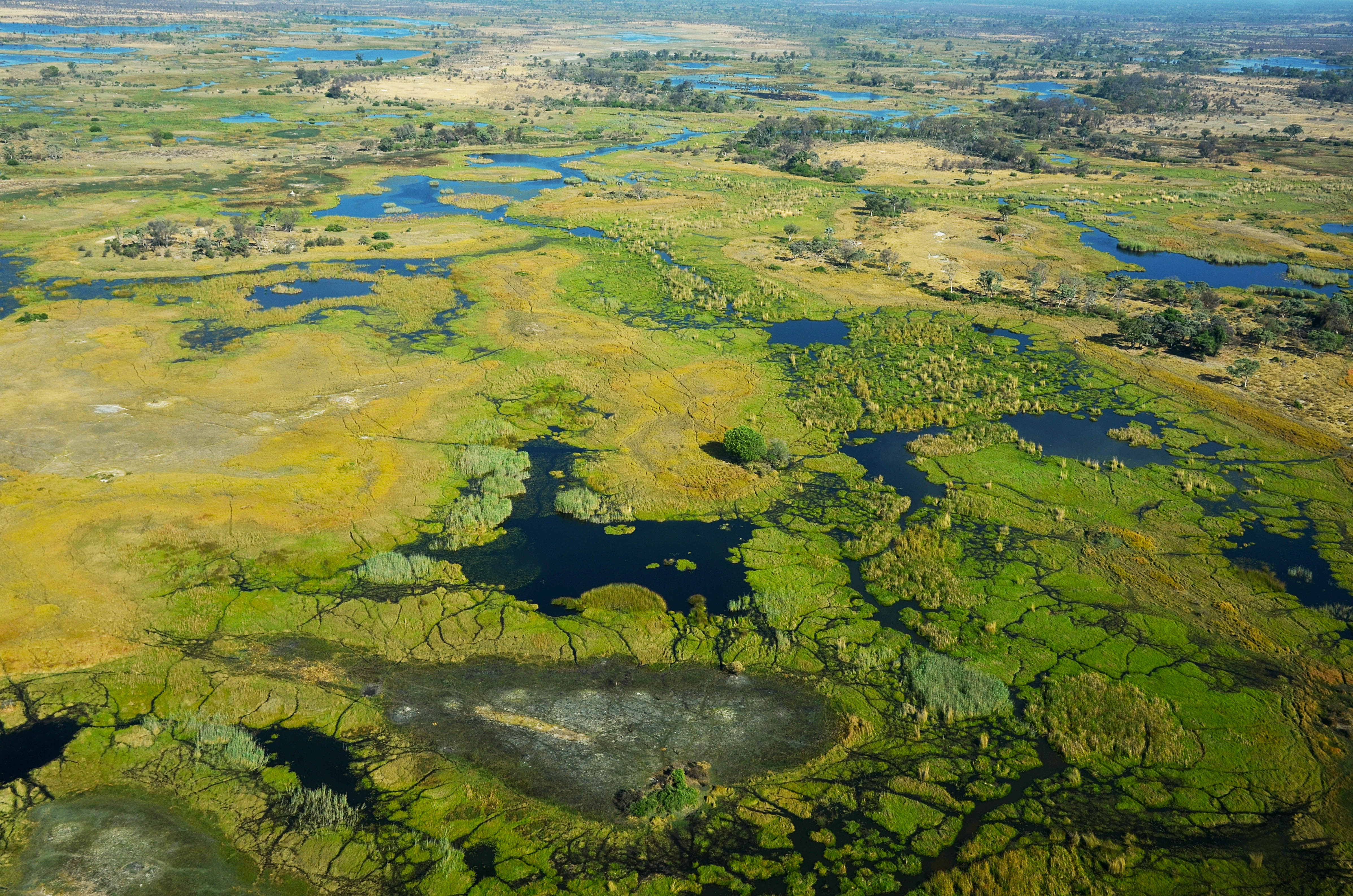

Imagine planning a trip around a flood. Normally you would expect the land to swell after local rain. In Botswana's Okavango Delta, the apparent logic is reversed: some floodplains fill during the dry season, when the surrounding Kalahari is receiving relatively little local rain. Water seems to arrive as if the landscape has a delayed memory.
The explanation begins far upstream.
THE LONG ROAD FROM ANGOLA Rain in the river's upstream catchment travels through a low-gradient system before reaching the inland delta in north-western Botswana. That pulse spreads across broad floodplains and permanent marshes. UNESCO identifies the unusual timing as a defining feature: annual flooding overlaps Botswana's dry season, and plants and animals are synchronized with the flood cycle. Namibia's UNESCO tentative-list description identifies a dry-season flood peak in Botswana around June and July, although actual timing, depth and access vary by place and year.
The Okavango is also a geographic surprise. It is an inland delta, not an estuary flowing to the sea. Its channels distribute water across a vast fan, and much of the water is lost to evaporation and transpiration or to the broader landscape rather than continuing into an ocean. The result is a mosaic of permanent water, islands, temporary channels and seasonally wet grassland.
AN ECOSYSTEM RUNNING ON TWO CLOCKS The local rainfall clock and the distant flood clock are not synchronized. Their overlap produces extraordinary ecological variation. Areas that are dry or grassy for part of the year become channels or shallow wetlands when the flood arrives. Nutrients, water access, grazing, movement routes and habitat availability change with it. UNESCO notes that the interplay among hydrology, climate, geomorphology and biology is central to why this is a World Heritage landscape.
Even the islands have a story. Gradients created through processes such as mineral precipitation help produce different habitats within small distances. A raised patch can support trees while a nearby depression carries aquatic plants or seasonally flooded grasses. A landscape that looks simple from an aircraft is actually layered in elevation and time.
THE TRAVEL MISTAKE: CHOOSING A MONTH WITHOUT CHOOSING A PLACE “Visit during the flood” sounds like straightforward advice. It is not. Different parts of the delta connect to water in different ways, and access, wildlife movement, weather and local conditions shift. A trip marketed as a water safari is not automatically the same experience in every concession or every week of the season. Responsible planning considers where the itinerary actually goes, what is accessible and the environmental practices of the operator.
A good traveler asks three questions before paying for an itinerary. Which part of the delta is this? What is the expected water access during our dates, acknowledging uncertainty? How does the operator manage wildlife distances, waste, community benefit and guide practices? Answers should be specific rather than vague promises that every animal will be visible.
THE SENSORY STORY Travel writing often uses dramatic animals as the headline. Here the river itself is the protagonist: it is a traveling seasonal signal that reaches the desert after the weather has changed. The wildlife is spectacular, but the most memorable detail may be the first line where dry grass meets floodwater.
Plan the experience, then choose the dates
Two travelers can book the same month and return with different impressions because their trips occupied different parts of this moving mosaic. One may spend time beside permanent channels; another may depend on a seasonal floodplain that is not connected in the same way that year. Treat the delta as a set of habitats and access conditions, rather than a single attraction with an on switch. A photograph of a boat on blue water cannot establish what a particular camp will offer on your dates.
Here is a planning exercise, not a proposed itinerary. Write down the experience you would be disappointed to miss: quiet time on the water, walking with a qualified guide, watching birds, or understanding the floodplain ecology. Ask an operator to connect that priority to a named area and an actual activity. Then ask what happens if water conditions differ. A useful answer explains alternatives, who decides whether an activity runs, and how that decision affects the booking. An unqualified promise of perfect conditions tells you less than a clear explanation of the limitations.
Keep a second column for the costs of access. Transfers, luggage limits, travel time between locations, group size and the physical demands of activities can change the character of a trip as much as a wildlife list. Confirm current arrangements with the operator before paying. These are questions for evaluating an offer, not verified prices or entry requirements. The flood's timing is the reason to ask them, not a substitute for the answers.
Finally, investigate community benefit in concrete terms. Who guides the activity? What local partnerships does the operator describe, and can it explain how those arrangements work? How are waste and wildlife encounters managed? A label such as sustainable travel does not resolve those questions. For a landscape whose life depends on connections across a large river basin, responsible travel begins by understanding that the view from your accommodation is only one small part of the system. The most interesting destination is often the one that changes the questions you bring home.
Unbound Travel Co. is interested in landscapes like this because they reward understanding before arrival. This article is an educational destination feature, not an announcement of a booked Okavango trip, a confirmed itinerary or an affiliated local tour. Trip enquiries and planning interest can be sent through https://unbound.villageropen.org/events.
Read the original sources
UNESCO World Heritage Centre: 1432 ↗UNESCO World Heritage Centre: 6098 ↗Sources checked October 26, 2026. Time-sensitive details should be checked again before acting.
Plan your next trip with Unbound. Tell us your dates, interests and group size. Itinerary, price and availability are confirmed before booking.
Explore experiences →Request trip planning →