The tidepool that appears for an hour and vanishes again
A rocky beach is not a fixed destination. On Washington's Olympic Coast, the same patch of stone can be a submerged neighborhood at breakfast and a tiny open-air aquarium later in the day. The difference is.
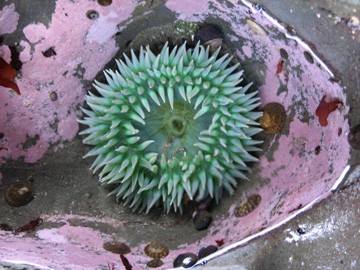
A rocky beach is not a fixed destination. On Washington's Olympic Coast, the same patch of stone can be a submerged neighborhood at breakfast and a tiny open-air aquarium later in the day. The difference is the tide, and the best way to experience it is to plan around a window of time rather than a list of attractions.
An entire community between two tide marks
At Olympic National Park, visitors may encounter sea stars, anemones, barnacles, crabs, nudibranchs and coralline algae in intertidal habitat. These are not decorations in a pool. They are organisms adapted to repeated immersion, exposure, temperature changes and wave force. An anemone that looks like a flower is an animal; its tentacles are part of its feeding apparatus.
The National Park Service names Kalaloch Beach 4 and Hole in the Wall near Rialto Beach among the best-known tidepool destinations. Ruby Beach, Second Beach and Third Beach also offer intertidal exploration. That does not mean every location is equally accessible at every tide or that every visitor should attempt a remote route.
Why low tide is not one simple number
A tide chart has highs and lows, but the height of the low matters. NPS recommends looking for especially low or minus tides, and notes that tidepools are generally better exposed when the tide is lower than one foot. The exact time changes from day to day. A person who arrives at the parking lot at the moment of low tide may miss the usable window after walking to the shore.
Hole in the Wall illustrates the problem. NPS describes a 1.5-mile walk from Rialto Beach to the formation and advises arriving at the destination at least thirty minutes before the lowest tide. The arch is not a passage to use once incoming water begins to cover its floor. Waves and falling rock are real hazards. A scenic photo cannot tell you whether the route is safe now.
A more interesting way to observe
Choose one small area and spend ten minutes watching before moving on. Find an exposed barnacle colony, a pool shaded by rock, and a nearby surface drying in the air. Notice how different those microhabitats are even though they sit only a few steps apart. Photograph without moving animals or prying them loose.
NPS and the Olympic Coast National Marine Sanctuary advise stepping on bare rock where possible, replacing any lifted rock exactly as found, leaving living organisms attached, and watching the returning tide and unexpected waves. The rule is not simply to leave no trash. It is to avoid turning a brief visit into an ecological disturbance.
Travel as attention, not extraction
A memorable itinerary does not require a packed schedule. For this coast, it might include one well-chosen low-tide window, a long pause to study the organisms and enough margin to return before water cuts off the route. The payoff is noticing a living world that appears and disappears on its own schedule.
Unbound Travel Co. shares real destination stories and responsible adventure planning. This article is travel inspiration, not a confirmed group trip, reservation or guide service. Explore planning inquiries at https://unbound.villageropen.org/events.
Read the original sources
www.nps.gov ↗www.nps.gov ↗www.nps.gov ↗Sources checked October 29, 2026. Time-sensitive details should be checked again before acting.
Plan your next trip with Unbound. Tell us your dates, interests and group size. Itinerary, price and availability are confirmed before booking.
Explore experiences →Request trip planning →