Glacier Bay: the forest written after the ice
In Alaska's Glacier Bay, exposed rock can become an alder thicket and eventually spruce forest. The sequence is a living map of ecological change.
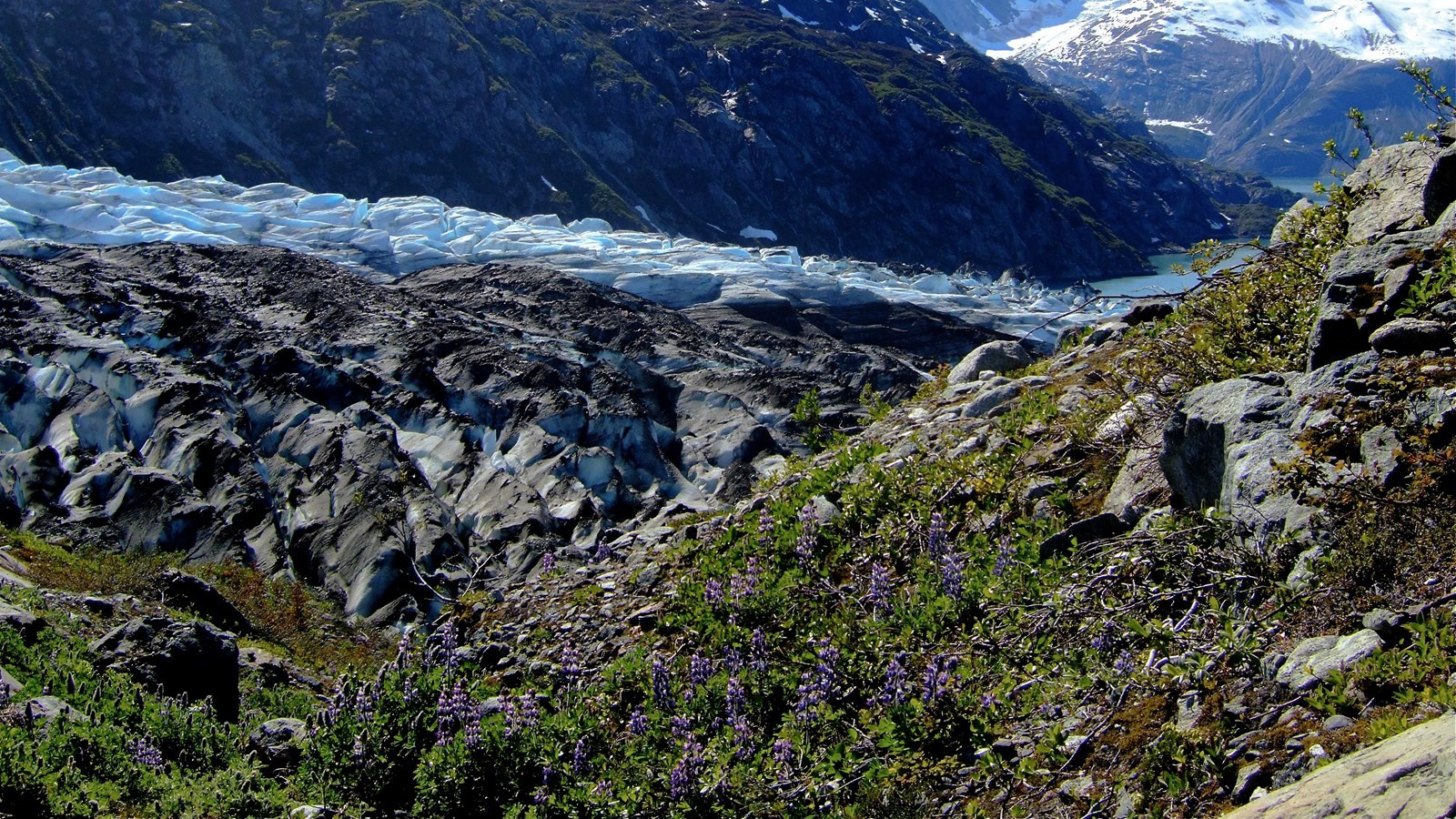
A retreating glacier leaves something that looks like the end of a landscape: raw stone, scraped gravel, unstable silt and an almost impossible absence of soil. In Glacier Bay, Alaska, it can also be the beginning of a forest.
This is not a metaphor. Glacier Bay National Park and Preserve is one of the world's clearest places to observe ecological succession because the glacier has uncovered land at different times. Traveling through the bay reveals a sequence of communities that arrived after the ice disappeared.
The first residents have almost nothing
Newly exposed ground offers little organic matter and often very little nitrogen. A plant that needs rich garden soil cannot simply establish itself on bare rock. The first visible settlers include lichens, mosses, Dryas and other hardy pioneers. They exploit cracks, trap moisture, weather rock and accumulate small amounts of organic material.
The National Park Service describes this landscape as a living record. Its plant succession exhibit explains how flowers such as Dryas appear in crevices after the ice leaves, and how the earliest plants begin making conditions suitable for others.
This is one of the most striking reversals in ecology: the first organisms are not merely occupying a place. They are changing the conditions that later organisms inherit.
The alder stage changes the soil
In the Park Service's interpretive sequence, alder can create leafy shade in roughly eighty years. Alder is important partly because of its relationship with nitrogen-fixing microorganisms. It can help enrich soils that were initially poor in available nitrogen. Leaf litter, roots and fallen stems slowly build the organic layer.
Alder does not create a perfect nursery for every species, and the succession is not a rigid assembly line. Microtopography, moisture, seed arrival, erosion and browsing all matter. But the broad pattern is visible: low pioneers make way for shrubs and deciduous trees, and eventually for conifers.
At a later stage, Sitka spruce can become prominent. The Park Service's visitor exhibit describes spruce dominance around two hundred years in its illustrative sequence. Other park resources describe spruce and hemlock forests on older terrain and emphasize that actual timing varies among sites.
The glacier becomes a timeline
A conventional forest hike moves through space. Glacier Bay can feel like a journey through time. Near younger exposed surfaces, the vegetation is sparse. On older terrain, shrubs and alder appear. Farther from the active ice, taller forest can develop.
Scientists have studied this process for more than a century. The Park Service notes early long-term work by William S. Cooper beginning in 1916. The bay therefore offers more than a scenic photograph of ice: it is a rare opportunity to compare the ecology of places exposed at different times.
This does not make every green slope a straightforward measure of glacier retreat. Glacial history, slope, drainage and salt exposure must be considered. The scientific value comes from comparing sites carefully, not assuming that every patch of vegetation has the same age.
Visiting without turning the experiment into a footprint
The ethical way to experience this landscape is to respect its fragility. A newly colonizing surface may be held together by a thin crust of living organisms. Repeated footsteps can damage the very process people have come to see. Use established routes and guided access where required, keep wildlife distance, and follow current National Park Service restrictions.
Photographing a transition between bare stone and green growth can tell a stronger story than another close-up of glacier ice. Try framing the rock, pioneer plants and older forest together. Record the exact location only when sharing it will not encourage damaging off-trail traffic.
The accompanying National Park Service photograph shows lupines and other hardy plants in rocky terrain near Lamplugh Glacier. It is editorial evidence of the park's plant life, not a photograph of an Unbound Travel Co. group.
A glacier changes the land twice: first by removing what was there, and then by leaving room for a succession of new living communities. The return of a forest is not a single event. It is a long series of small arrivals, each making the next one more possible.
Explore travel planning and inquiry options at https://unbound.villageropen.org/events. Trips, dates and availability are not represented as confirmed here.
Read the original sources
www.nps.gov ↗www.nps.gov ↗www.nps.gov ↗Sources checked October 29, 2026. Time-sensitive details should be checked again before acting.
Plan your next trip with Unbound. Tell us your dates, interests and group size. Itinerary, price and availability are confirmed before booking.
Explore experiences →Request trip planning →